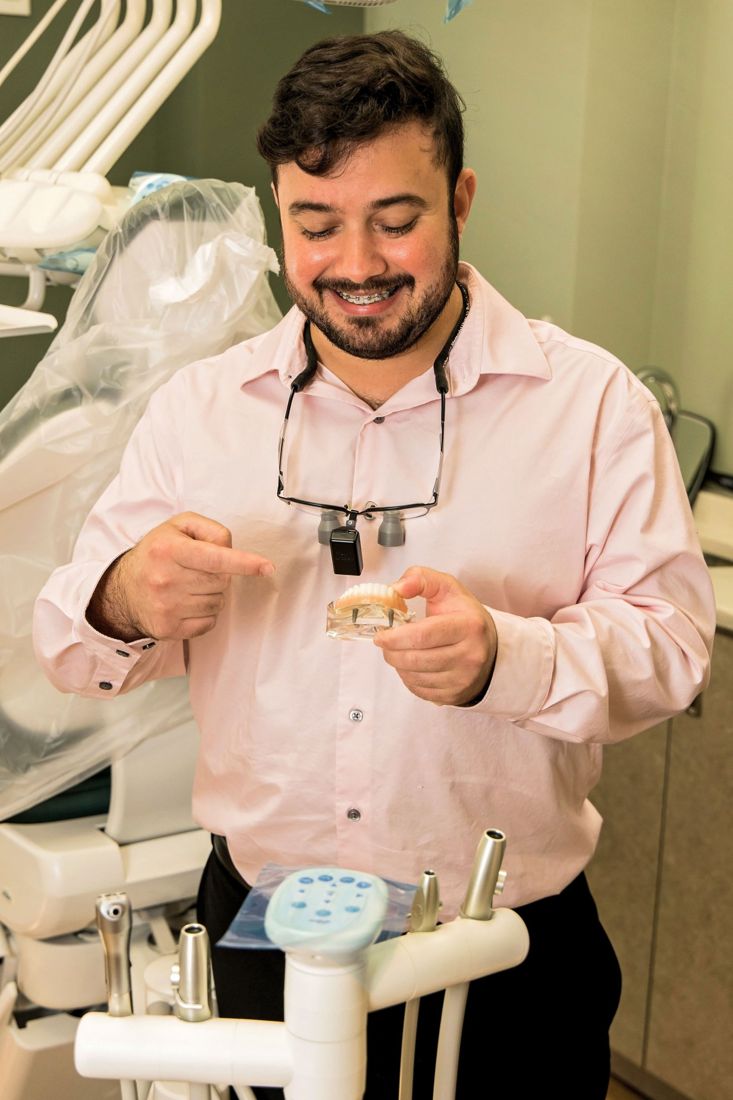
What is a dental implant?
A dental implant is a small titanium post placed in your jaw to act as a new tooth root. Once it heals, it’s topped with a custom crown, bridge or denture so you can chew, speak and smile with confidence again.
A permanent solution for missing teeth
A dental implant is the closest thing to a natural tooth. A small titanium post is placed in your jaw to act as a new tooth root. Once it heals, we top it with a custom crown, bridge or denture so you can chew, speak and smile with confidence again.
Implants are a great fit if you’re missing one tooth, several teeth or a full arch – or if you’re tired of a denture that slips or a bridge that needs replacing.
At Goodall Family Dentistry, you won’t be sent to an outside specialist. Dr. Booker places every implant in our office. He completed extensive implant training through Implant Pathway and is pursuing Diplomate status with the International Congress of Oral Implantologists (ICOI). Once your implant has healed, Dr. Booker or Dr. Goodall designs and places your final crown, bridge or denture – so every step happens in our office, from your 3D scan to your final smile.
Implant options for every smile
Single tooth implant
Replaces one missing tooth with an implant and a custom porcelain crown. It looks and works like a natural tooth – without touching your healthy neighboring teeth.
Implant-supported bridge
Missing several teeth in a row? Two implants can hold a permanent bridge – no removable partial denture needed.
Snap-on implant denture
A full denture that snaps securely onto 2–4 implants. Far more stable than a regular denture, and you can still take it out to clean.
Fixed full-arch implants (“All-on-4”)
A full row of teeth permanently attached to 4–6 implants. Only your dentist removes it – the closest feel to natural teeth.
Schedule an Implant Consultation
Told you’re not a candidate for implants?
Don’t lose hope. Implant techniques and materials have come a long way, and we often help patients who were turned away elsewhere.
- Not enough bone? We routinely rebuild the jawbone with bone grafting – using PRF from your own blood to help it heal stronger.
- Bleeding disorder or complex health history? We work closely with your physician or hematologist on a safe plan before, during and after treatment.
- Unsure what’s possible? A consultation with a 3D scan shows us exactly what we’re working with, so we can walk you through every option.
Your implant journey, step by step
- Consultation & 3D scanWe review your health history, take a 3D scan, talk through your options and give you a written estimate.
- Preparing the site (if needed)If a damaged tooth needs to come out or the bone needs support, we remove the tooth and place a bone graft with PRF. This heals for 3–6 months.
- Implant placementThe area is fully numbed. Most patients are back to normal activities within a day or two.
- HealingOver 3–6 months, your jawbone bonds to the implant, creating a strong foundation.
- Your new smileA short visit to uncover the implant, then we attach your custom crown, bridge or denture.
- Keep it healthyRegular cleanings and checkups help your implant last for decades.
The full process usually takes 9–12 months. We don’t rush healing – it’s what makes implants last.
Advanced technology for healthier, longer-lasting results
BioHorizons implants with Laser-Lok®
We place only BioHorizons implants. Their patented Laser-Lok surface helps your gums and bone attach to the implant, much like a natural tooth – helping protect against infection and gum recession.
Learn more
Most implants only bond with bone – the gum simply rests against the metal. Laser-Lok’s tiny laser-made grooves let gum tissue attach too, forming a seal that helps keep bacteria out, protect the bone, and keep gums from pulling back and showing metal. In one 5-year study of 500 Laser-Lok implants, 98.7–99.6% were successful.*
*Günbay et al., Survival and Success of Implants with Laser-Lok Microchannels: A Retrospective Study of Cases with 5-Year Follow-Up, Ege University Faculty of Dentistry Journal, 2021. Individual results vary.
PRF for faster, more comfortable healing
We use PRF – a natural healing material made from a small sample of your own blood – during extractions and bone grafting.
Learn more
PRF concentrates your body’s own growth factors. We place it over the surgical site as a protective “biological bandage” or mix it into bone grafts. It helps speed healing, reduce swelling and discomfort, and lower the risk of dry socket after an extraction.
3D imaging for precise planning
Our CBCT 3D scan shows your bone and nerves in detail, so every implant is planned for the right spot before treatment begins.
Nitrous oxide available · Warm blankets · Movies and shows during treatment
Implants vs. bridges vs. dentures
| Dental implant | Bridge | Removable denture | |
|---|---|---|---|
| How long it lasts | Decades, often a lifetime (crown may need replacing in 10–15 years) | Often 10–15 years | Needs relining or replacing every several years |
| Protects your jawbone | ✓ Yes – acts like a tooth root | ✗ No | ✗ No – bone can shrink over time |
| Affects nearby teeth | No | Yes – neighboring teeth are reshaped for crowns | Partials can stress the teeth they clip onto |
| Daily care | Brush and floss like natural teeth | Special floss threaders | Remove nightly to clean |
| Feel & chewing | Closest to natural | Good | Least stable; may slip |
| Upfront cost | Highest | Moderate | Lowest |
Making implants affordable
Every implant plan is unique. Cost depends on how many teeth are replaced, the type of restoration, and whether you need extractions or bone grafting. At your consultation, you’ll get a clear, written estimate – no surprises.
Many insurance plans cover part of implant treatment, and we’ll check your benefits for you. We also partner with Cherry and CareCredit for flexible monthly payments. We offer an in-house membership plan for patients without insurance.
See insurance & new patient info
Explore dental implants
Frequently asked questions
What is a dental implant?
A dental implant is a small titanium post placed in your jaw to act as a new tooth root. Once it heals, it’s topped with a custom crown, bridge or denture so you can chew, speak and smile with confidence again.
How long do dental implants last?
With good care, the implant itself can last decades – often a lifetime. The crown on top may need replacing after 10–15 years due to normal wear.
Is getting a dental implant painful?
Most patients say it’s more comfortable than they expected. The area is fully numbed, nitrous oxide is available, and most people return to normal activities in a day or two.
Am I a candidate for dental implants?
Most healthy adults with missing teeth are candidates. If you’ve been told you don’t have enough bone, or you have a bleeding disorder or complex health history, we may still be able to help with bone grafting and close coordination with your physician. A 3D scan at your consultation tells us for sure.
How much do dental implants cost?
Every implant plan is unique. Cost depends on how many teeth are replaced, the type of restoration, and whether you need extractions or bone grafting. At your consultation, you’ll get a clear, written estimate with no surprises. Flexible monthly financing is available through Cherry and CareCredit.
Does insurance cover implants?
Many plans cover part of the implant placement, crown or full restoration. We’ll check your benefits for you.
Do you place implants in-house or refer out?
Dr. Booker places implants right here in our office, and both Dr. Booker and Dr. Goodall restore them with crowns, bridges and dentures. We can also replace worn, chipped or outdated implant crowns, bridges and dentures – even if your implant was placed elsewhere.
What type of implants do you use?
We place only BioHorizons implants. Their patented Laser-Lok® surface helps both your gums and bone attach to the implant, creating a natural seal that helps protect against infection, bone loss and gum recession – for a healthier, more natural-looking result.
What is PRF, and why do you use it?
Platelet-Rich Fibrin (PRF) is a natural healing material made from a small sample of your own blood. We place it at extraction and graft sites to help speed healing, reduce swelling and discomfort, and lower the risk of dry socket.
Dental Implants vs. Bridges: How to Choose the Right Tooth Replacement
Read the articleReady to schedule?
Book online anytime, or call our front desk — we’re happy to answer questions about scheduling, insurance or your visit.